
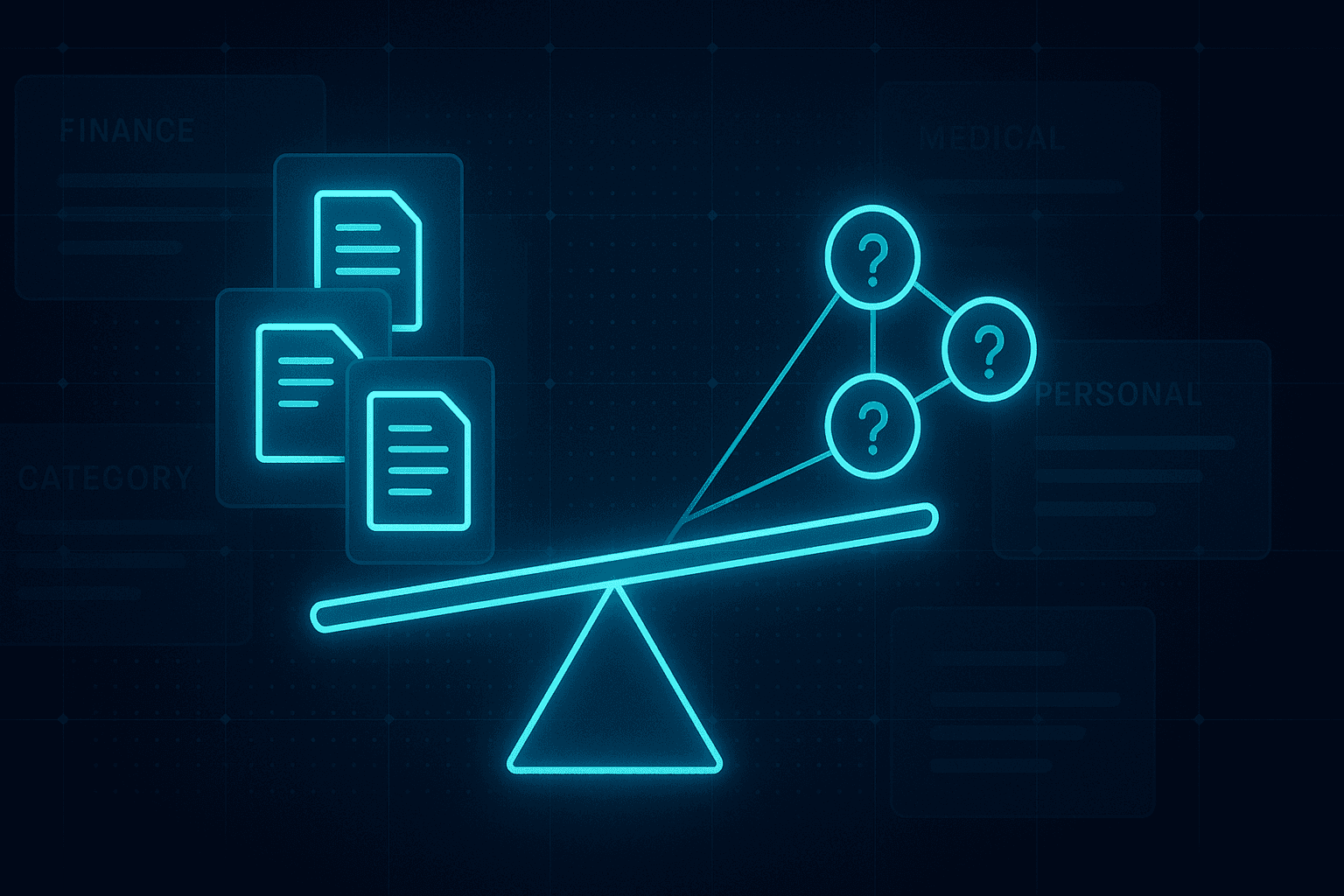
The Bias Problem in AI-Powered Document Organization
Your AI reads a document titled "Women in Leadership" and automatically tags it under HR policy. It flags a contract from a vendor you've never heard of as lower priority than one from your established partner—not because of terms, but because it doesn't recognize the name. It categorizes an email from your international team as "lower priority" because the writing style doesn't match typical corporate patterns.
None of these decisions feel wrong. They're not dramatic. But they're all examples of how AI systems, when tasked with organizing and analyzing content, can quietly reinforce existing organizational biases and create new ones.
This isn't a problem unique to AiFiler. It's endemic to how AI works. But it's also a problem that most document management vendors don't talk about—because acknowledging it means admitting their systems might be making decisions in ways their users can't see or control.
Where the Bias Enters
AI bias in content analysis happens at multiple stages, and understanding them matters if you're building an organization that relies on AI to manage information.
Training data bias. Language models learn patterns from text. If the training data contains patterns that reflect real-world inequities—say, documents written by men getting more prominence in certain industries, or certain groups being underrepresented in certain roles—the model learns to replicate those patterns. When AiFiler's AI analyzes a document, it's not starting from a blank slate. It's working with learned associations.
Intent inference bias. When your AI system tries to understand what a document is "for," it makes assumptions based on language, structure, and context. A technical specification written by a junior engineer might get tagged differently than the same specification written by a senior one, even though the content is identical. The AI has learned that seniority correlates with authority, so it infers different intent.
Organizational embedding bias. Here's the subtle one: your organization already has biases baked into how it categorizes, prioritizes, and routes information. If your current system flags documents from certain departments as less urgent, or if your search patterns show that information from certain teams is accessed less frequently, an AI system will learn those patterns and reinforce them. It's not creating the bias—it's automating it.
Completeness bias. AI systems work with the documents they have access to. If certain perspectives, teams, or viewpoints are underrepresented in your document store, the AI will have incomplete information about your organization's full picture. When it makes recommendations or categorizations, it's doing so with a distorted view of reality.
Why This Matters More Than You Think
The immediate instinct is to say: "This is fine. AI is just helping us organize faster. If there's a bias, we can correct it manually."
That misses the scale problem. If you're using AI to organize hundreds or thousands of documents, you're not reviewing every decision. You're trusting the AI to make reasonable choices. And as AI systems get better at sounding confident and authoritative, users trust them more—even when they shouldn't.
McKinsey research on AI adoption found that organizations implementing AI systems without explicit bias auditing saw measurable increases in decision-making inequity within 6-12 months. Not because the AI was malicious, but because no one was checking whether the patterns it was learning and reinforcing matched the organization's actual values.
There's also a legal dimension. If your AI system categorizes documents in ways that disadvantage certain groups—say, systematically deprioritizing documents from certain vendors or teams—and that decision-making pattern becomes discoverable in litigation, you're not just dealing with a technical problem. You're dealing with a liability.
AiFiler's Approach: Transparency Over Black Boxes
We've thought about this problem since day one, and our approach is built on a simple principle: if an AI system is making decisions about your information, you need to understand how and why.
This shapes several design choices:
Citations in every analysis. When AiFiler's AI analyzes a document or suggests a categorization, it shows you which parts of the document it's basing that decision on. You can see the evidence. Open Universal Command (Ctrl+Shift+A) and ask for a document summary or category suggestion—the AI doesn't just tell you the answer. It shows you the relevant passages. This isn't just better UX. It's accountability built into the interface.
Execution policies for sensitive operations. When you're using AiFiler to batch-process documents or apply organizational rules at scale, you can set policies that require human review for certain decisions. Click the three-dot menu on any batch operation and you'll see options to flag high-stakes categorizations for manual approval before they're applied. The AI makes the suggestion; you make the decision.
Search transparency. AiFiler's Search Parser breaks down how it's interpreting your search query. If you search for "high-priority vendor contracts," the system shows you which terms it's weighting heavily and why. This prevents silent misinterpretations where the AI thinks it understands your intent but actually doesn't.
Bias auditing as a built-in feature. In your workspace settings, you can run an audit that shows you which document categories, vendors, or teams are being systematically deprioritized or overweighted in AI recommendations. It's not perfect—bias detection is itself imperfect—but it's a start. Most document management systems don't give you this option at all.
The Harder Questions
Being transparent about bias is necessary but not sufficient. There are questions that don't have clean answers:
Who decides what counts as bias? If your organization has decided that vendor contracts from established partners should be treated as lower-risk, is it bias for an AI system to learn that pattern? Probably not. But if the AI is also learning that contracts from vendors founded by women are systematically treated as higher-risk, that's a different problem. The line between "organizational knowledge" and "organizational bias" is blurry.
How much human review is practical? If you're processing 500 documents a day, you can't manually review every AI decision. But if you don't review any of them, how do you know when the system starts drifting? There's no perfect answer, but the question itself matters. Organizations that ask it tend to catch problems earlier than ones that don't.
What about the bias you can't see? Some of the most consequential biases in AI systems are the ones that are mathematically subtle. The system might be making perfectly reasonable decisions 95% of the time, but systematically wrong decisions about a specific subset of documents—and you'd need statistical analysis to catch it. Most organizations don't have the expertise to do that analysis.
The Takeaway: Responsibility Is a Choice
The uncomfortable truth is that most AI document management systems don't surface these questions because doing so is harder to sell. It's easier to promise that AI will organize your documents faster and better. It's harder to say: "AI will organize your documents faster, but you need to actively monitor whether it's doing so fairly, and here's what that looks like."
AiFiler's approach isn't perfect. No AI system is. But it's built on the assumption that if you're using AI to make decisions about your organization's information, you deserve to understand how those decisions are being made—and you deserve tools to catch when those decisions start reinforcing biases you don't intend.
That's not a technical problem. It's a choices problem. And the choice to build for transparency, even when it's harder, is what separates systems that amplify organizational intelligence from systems that amplify organizational blind spots.
Enjoyed this article?
Get more articles like this delivered to your inbox. No spam, unsubscribe anytime.